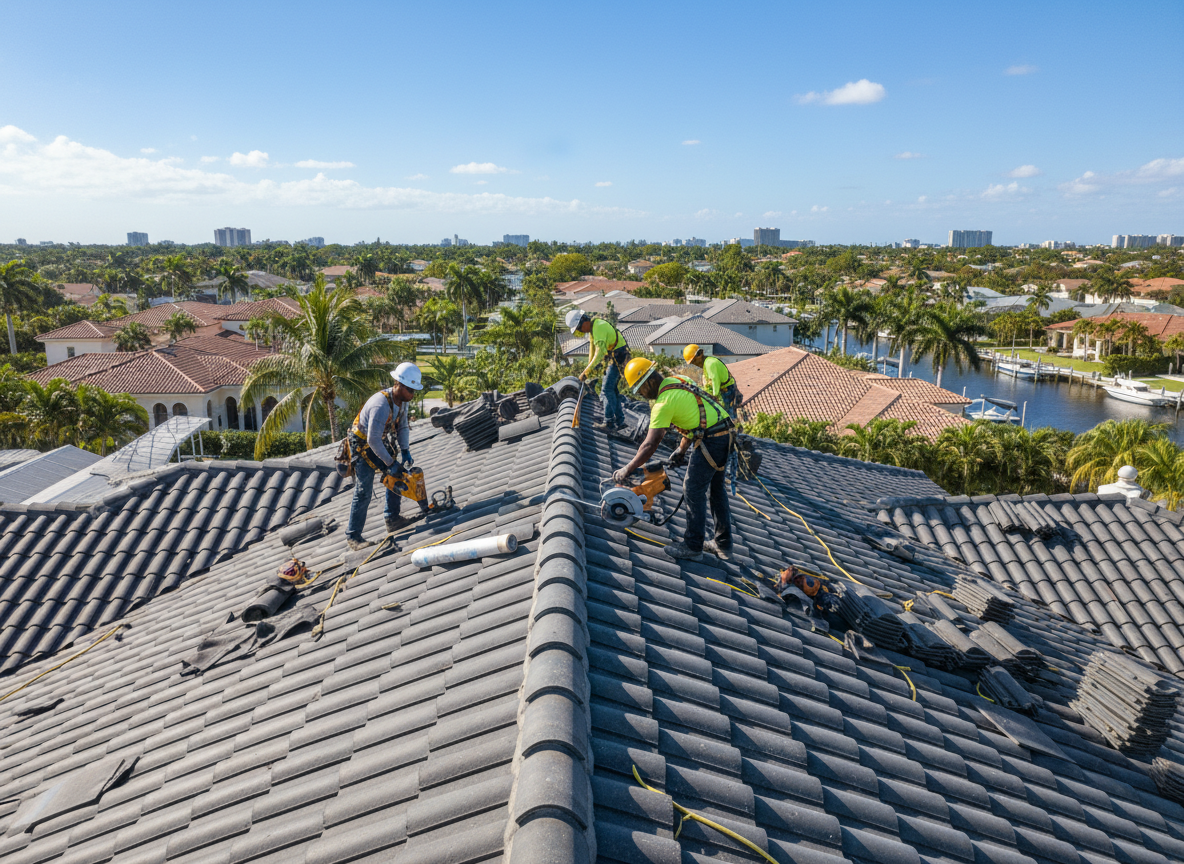
A tropical storm moves through Broward overnight. By morning there are lifted shingles in the yard, a cracked barrel tile on the patio, or a brown ring spreading across the bedroom ceiling. The question is not whether to fix it. The question is how to stop the water today and repair it so the roof still passes code. Roof Repair Fort Lauderdale handles storm damage roof repair from the first tarp to the final permitted fix. When you need emergency roof repair in Fort Lauderdale, call (954) 910-2948 to book a roof inspection.
Why Homeowners Call Roof Repair Fort Lauderdale
Search for storm help in this city and much of what comes up is storm damage restoration: companies that dry out drywall and pull wet carpet. That work matters, but it starts after the roof is sealed. We are a storm damage roofer. Our job is the roof itself, from residential roof repair after a named storm to the everyday leaks between seasons.
Fort Lauderdale sits inside the High Velocity Hurricane Zone (HVHZ) of the Florida Building Code, which covers Broward and Miami-Dade counties. Repairs here are held to stricter rules than most of the state. Every roofing component must carry a current product approval and be installed exactly as that approval describes. We build each repair around those rules from the start, so the work is not redone later to satisfy an inspector.
You get a straight answer on scope. After a storm, some roofs need a small roof repair, some need a section rebuilt, and some have crossed the line where the 25% rule (explained below) forces a larger job. We tell you which one you are looking at and why, before any work starts. Not every call is a big job, and we treat roof fixing on a single lifted shingle as seriously as a full section.
What we do on storm jobs:
- Roof inspection with photos of what we find
- Emergency tarping to stop water entry while the permanent repair is planned
- Leak detection and repair, including leaks that only show up in wind-driven rain
- Shingle, tile, flat and metal roof repair
- Photos and measurements of roof damage that you can give your insurer
If you plan to file an insurance claim, you are responsible for paying your insurance deductible. We do not waive, pay or rebate any part of a deductible. We are not public adjusters: we do not file, handle, negotiate or guarantee insurance claims.
Why Fixing Storm Damage Now Matters in Fort Lauderdale
Damage that looks small rarely stays small here. The National Weather Service in Miami defines the South Florida rainy season as 15 May to 15 October, and those months bring most of the year's rain. A lifted shingle or slipped tile that lets in a little water in June can soak the decking through months of afternoon storms. A roof that took a hit early in the season then faces the peak tropical months of August, September and October with an open weak spot.
Timing also matters if you decide to report the damage to your insurer. Under Florida Statute 627.70132, notice of a new property insurance claim must reach your insurer within one year of the date of loss. For hurricanes and windstorms, that date is the landfall date or the date NOAA verifies the event. Waiting to see whether a stain grows can cost you the window to report it, and photos taken soon after the storm make it easier to show the damage came from wind, not age.
Emergency roof repair in Fort Lauderdale is mostly about stopping secondary damage. Wet insulation, swollen drywall and damp attic framing are what turn a roof repair into a much larger interior repair. A tarp installed correctly buys time to plan the permanent fix and pull the permit.
The 2026 hurricane season runs through 30 November. If your roof took any damage this year, an inspection now tells you what it will face during the rest of the season.
Proof: What You Can Check for Yourself
We would rather show you how the work is done than ask you to take our word for it. Everything below can be verified with the City of Fort Lauderdale, Broward County or the State of Florida.
HVHZ code compliance. Broward County is in the High Velocity Hurricane Zone. Roof work here follows the HVHZ sections of the Florida Building Code, which are stricter than the rest of the state.
Miami-Dade product approvals. The City of Fort Lauderdale roofing permit packet asks for a Miami-Dade County Notice of Acceptance (NOA) for the roofing products used. We install products with current approvals and can show you the NOA for any material we put on your roof.
City of Fort Lauderdale permits. Re-roofing work in the city goes through a building permit with the HVHZ Uniform Roofing Permit Application used across Miami-Dade and Broward. Where the job value requires one under Florida law, a Notice of Commencement is recorded with Broward County. For re-roofs, the packet also includes an asbestos statement. You can look up any permit we pull through the city.
Written scope. Before any work starts, ask for a written scope that names the roof system, the NOA numbers for its products, whether a city permit is needed, and exactly what the job includes. You can then check every line against the finished roof.
Warranty terms in writing. Whoever you hire, ask for every warranty term in writing before you sign. If it is not written into the scope, it is not a promise.
When Wind Damage Meets the 25% Rule
This is the situation that catches many Fort Lauderdale homeowners off guard after a hurricane, and none of the storm-repair pages that rank for this city explain it.
The Florida Building Code limits how much of a roof can be repaired, replaced or recovered in any 12-month period. If 25% or more of a roof or roof section needs work in that window, the general rule says the whole roof or section must be brought up to current code. On an older roof, that can turn a storm patch into a full re-roof.
There is an important exception. Since 2022, Florida Statute 553.844(5) says that if the existing roof was built, repaired or replaced to the 2007 Florida Building Code or later, only the portion being repaired has to meet current code, even when it is 25% or more. The 2007 code took effect on 1 March 2009, which is the cutoff most people use.
What this means for you after a storm:
- Know when your roof was installed. A permit record for the last re-roof is the easiest proof. If your roof dates from before 2009, a large wind repair may trigger a full replacement requirement.
- Measure the damage honestly. We document the damaged area against the full roof section so you know the real percentage before deciding anything.
- Know the number before you report. If the damage is close to the 25% line, it changes the scope of the job, whether you pay for it yourself or report it to your insurer.
If your roof was put on after early 2009, the exception may let a large storm repair stay a repair. If it predates 2009, get an inspection before you assume a patch will be accepted. When the damage is beyond repair, our roof replacement page explains how a full HVHZ re-roof works in the city.
If you report this damage to your insurer, you are responsible for paying your insurance deductible. Florida Statute 489.147 prohibits contractors from waiving, paying or rebating any part of a deductible, and from offering anything of value in exchange for a roof inspection or a claim. We follow that law. We inspect, document and repair the roof. Your claim is between you and your insurer.
Storm Damage Repair: What We Work On
Wind-lifted and missing shingles
Shingles are designed to stay sealed to the course below, but strong gusts can break that seal and fold them back. A shingle that lifts and drops again may look fine from the street while its seal is broken and its nails are exposed. The value of catching this early is simple: a resealed or replaced shingle costs far less than wet decking underneath it. The finding usually leads to one of two decisions, spot repair or a section rebuild, depending on how many shingles lost their seal. After any named storm, walk the yard and look for shingle pieces or granules collecting at downspouts, and photograph what you find.
Cracked, slipped and missing roof tiles
Concrete and clay tile roofs take a particular kind of storm damage. During Hurricane Wilma in 2005, news reports described barrel tiles peeling off roofs across western Broward. A tile can crack from flying debris or slip when its adhesive or fastening fails. The tile is only the top layer. The underlayment below does the waterproofing, and a missing tile exposes it to sun and rain. Tile repair means matching or sourcing approved tile, resetting it to the product approval, and checking the underlayment around it. If you see a gap in a tile row or tile pieces on the ground, keep everyone off the roof, since tile breaks underfoot, and book an inspection.
Flashing and roof-to-wall joints
Flashing is the metal that seals the joints where the roof meets a wall, chimney, vent pipe or skylight. Wind can bend it, pull its fasteners or crack the sealant along its edge. Many storm leaks that appear far from any visible roof damage start at flashing. Water runs along the deck and shows up on a ceiling several feet away. Repairing flashing correctly prevents leaks that come back after every storm, which also protects your interior. If a stain sits near an exterior wall or below a vent, ask that the flashing be inspected before anyone replaces the ceiling.
Flat roof sections
Many Fort Lauderdale homes have a flat or low-slope section over a porch, addition or Florida room. Flat roofs fail differently from sloped ones. Wind can peel back membrane edges, and ponding water after heavy rain finds every seam. Fixing a flat section protects the rooms that usually sit under it, which are often the ones added later with less margin for error. The decision is usually between patching the membrane and replacing the section. If water stands on a flat roof for more than a day or two after rain, note where it collects and have it checked.
Metal roof panels and fasteners
Metal roofs handle wind well when installed to their approval, but storms can loosen fasteners, open panel seams or bend trim at the edges. Repair means re-securing or replacing panels and fasteners with approved components, not generic hardware. Getting this right keeps the roof's wind performance intact for the next storm, which is the reason most owners chose metal in the first place. After a high-wind event, look along the edges and ridge for lifted trim or panels that look out of line, and photograph anything that has moved.
Wind mitigation features
A wind mitigation inspection records the features that help a home resist wind: roof covering, how the roof deck is attached, roof-to-wall connections, roof shape, secondary water resistance and opening protection. Florida insurers use the state form OIR-B1-1802, revised effective 1 April 2026, to decide which wind-loss credits apply to your premium. Storm repairs can change these features, so a repair done to current code can matter at your next renewal. Ask your insurance agent whether a new wind mitigation form after repairs could affect your premium, and keep your repair invoice and permit record together for that inspector.
Four-point inspections and roof age
A four-point inspection is a separate report that many Florida insurers ask for on older homes. It covers the roof plus three other major systems in the house. The roof section focuses on age, condition and visible damage. Florida's 15-year roof rule also limits when an insurer can refuse a policy over roof age alone; our roof replacement page explains how it works. Unrepaired storm damage weakens your position under both, so if a renewal or a home sale is coming, fix storm damage before the inspection rather than after.
Book a Storm Damage Roof Inspection
Tell us what you are seeing: missing shingles, broken tile, a new ceiling stain or water coming in now. We will inspect the roof, photograph and measure what we find, tarp it if it needs protection, and explain whether you are looking at a repair or a larger job under Fort Lauderdale code. If you need a new roof instead, see roof installation.
Related services: [Roof Repair Fort Lauderdale home](/) · Roof Leak Repair · Roof Replacement · Roof Installation