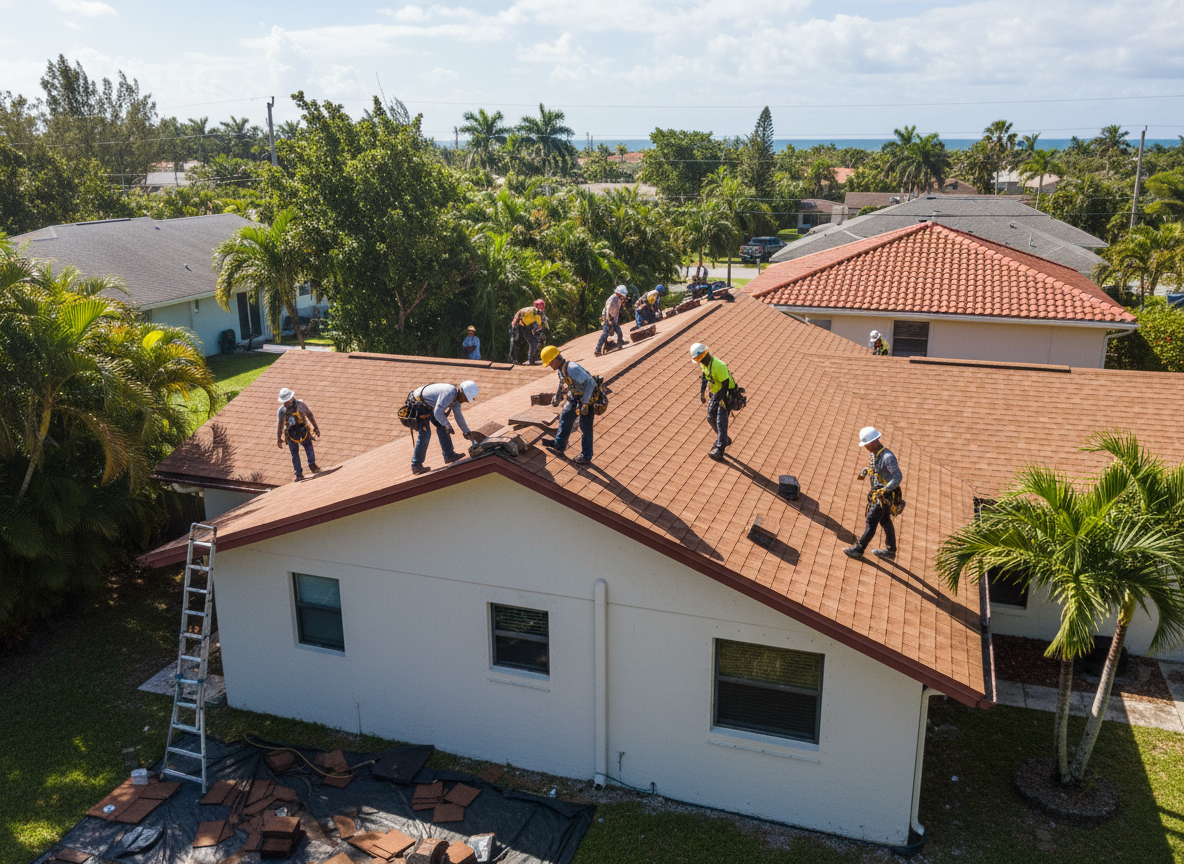
You are adding a bedroom over the old carport, enclosing the back porch, or building a new house on a cleared lot. The plans are drawn, and the roof is the line item everyone assumes is simple. In Broward County it is not. A new roof here is designed and installed for the High Velocity Hurricane Zone, with approved products, design calculations and inspections. Where an addition meets an existing roof, that joint decides whether the new room stays dry. Roof Repair Fort Lauderdale handles new roof installation from the product choice through the final inspection. Call (954) 910-2948 to talk through your project.
Why Builders and Homeowners Call Us
Search for a new roof in this city and the top results are directories and general roofing homepages. None of them explains how a new roof gets designed and permitted for the HVHZ, or what happens where a new roof meets an old one. Those two things are where most new-roof problems start, so they are where we put the most care.
Every new roof we install follows the Florida Building Code's HVHZ requirements for Broward and Miami-Dade. That means a roof system with a current Miami-Dade Notice of Acceptance (NOA), installed exactly as the approval specifies, and a permit application that carries the product approval pages and the design calculations for your roof.
We work with homeowners, designers and general contractors. If your project already has an architect or engineer, we work to their roof design and product schedule. If it does not, we help you choose a system that fits the house, the budget and the approvals available.
What a new roof with us includes:
- Review of your plans and the roof design
- Help choosing a tile, shingle, metal or flat roof system with a current Miami-Dade NOA
- The roofing permit application with product approvals and design information
- Installation to the product approval
- Tie-in to any existing roof, detailed to keep water out at the joint
- Inspections through to final, with the permit record for your files
Why the Roof Plan Matters Early
Decisions made late on a roof cost more. The roof system has to be chosen before the permit can be filed, because the HVHZ application needs the product approval pages for that exact system. Switching from shingle to tile after the structure is framed can change the loads the framing has to carry. Settling the roof early keeps the rest of the build on schedule.
The weather is the other reason. The NWS Miami rainy season runs 15 May to 15 October and brings most of the year's rain, and the hurricane season runs 1 June to 30 November. A new structure is exposed until the roof is dried in. Planning the roofing sequence around that window protects the framing and interior work underneath.
Finally, the code is changing. The 9th Edition (2026) Florida Building Code takes effect on 31 December 2026. Permits filed before then generally fall under the current 8th Edition (2023). Projects filed after must meet the new edition. If your project straddles that date, ask your designer which edition your permit will be reviewed under.
Proof: What You Can Verify
Everything here can be checked with the City of Fort Lauderdale, Broward County or the State of Florida.
HVHZ roofing application. New roofs and re-roofs in Fort Lauderdale use the HVHZ Uniform Roofing Permit Application for Miami-Dade and Broward, which requires the product approval pages and design calculations.
Miami-Dade product approvals. The City of Fort Lauderdale roofing packet requires a Miami-Dade NOA for the roofing products. We give you the NOA numbers for your system.
City permitting stops. The city's roofing packet lists building, mechanical and flood among the review stops. A rooftop equipment affidavit applies where equipment sits on the roof, and lightweight concrete roof decks have their own packet.
Written scope. Before any work starts, ask for a written scope that names the roof system, the NOA numbers for its products, whether a city permit is needed, and exactly what the job includes. You can then check every line against the finished roof.
Warranty terms in writing. Whoever you hire, ask for every warranty term in writing before you sign. If it is not written into the scope, it is not a promise.
Where the New Roof Meets the Old One
This is the part of a new roof installation in Fort Lauderdale that goes wrong most often, and none of the installation pages that rank for this city address it. When you add a room, enclose a porch or convert a carport, the new roof has to join an existing one. Two roofs of different ages, sometimes different materials and different slopes, meet along a line that has to shed wind-driven tropical rain.
What can go wrong:
- The joint itself. Where the new roof meets the old, flashing and underlayment have to lap correctly so water runs over the joint, not into it. A poor tie-in is a leak waiting for the first sideways storm.
- Disturbing the existing roof. Tying in usually means opening part of the old roof. On an older roof, the Florida Building Code's 25% rule can come into play: if 25% or more of a roof section is repaired or replaced within 12 months, the section may have to be brought to current code. Roofs built to the 2007 Florida Building Code or later are exempt under Florida Statute 553.844(5).
- Mismatched materials. A new tile roof next to an old shingle roof, or new tile next to weathered tile, needs a plan for how they meet and how the old side holds up.
How we handle it:
- We inspect the existing roof before the addition roof is designed, so the tie-in and any needed work on the old roof are in the scope from the start.
- We tell you if the existing roof is close to the 25% threshold or near the end of its life. Sometimes the better decision is to replace the existing roof at the same time, so both sides are new and built to the same standard.
- We detail the joint to the product approvals for both systems.
New Roof Systems
Shingle roof installation
Asphalt shingle systems approved for the HVHZ are usually the lowest-cost new roof. They are lighter than tile, which can simplify framing on an addition, and quicker to install. The trade-off is a shorter service life than tile or metal. A shingle roof suits additions on homes that are already shingle and projects where budget leads. If your addition will tie into an existing shingle roof, matching the system makes the joint simpler to detail.
Tile roof installation
Concrete and clay tile gives a long-lived covering. It is heavy, so the structure must be designed for it from the start, and every tile is attached to its product approval, which matters in hurricane wind. During Wilma in 2005, news reports described barrel tiles peeling off roofs across western Broward, which is why attachment is not a detail to rush. Choose tile early in the design, not after framing, and confirm the structure is designed for its weight.
Metal roof installation
Standing seam and metal panel roofs shed rain fast and perform well in wind when installed to their approval. Metal roof installers in the HVHZ work to a specific fastening pattern and clip spacing set by the NOA. Metal costs more upfront than shingle, but many owners choose it for service life. Near the coast, ask what the approved system specifies for fasteners and trim, since salt air is hard on exposed metal over time. Keep the NOA and installation records with your permit.
Flat roof installation
Flat and low-slope roofs cover many additions, porches and Florida rooms. They use approved membrane systems, and the key design decision is drainage: water has to leave the roof rather than pond on it. A flat roof that drains properly lasts; one that ponds wears out at the seams. Some flat roofs use lightweight concrete decks, which the City of Fort Lauderdale permits through a separate packet. Settle the slope and drain locations in the design, not on the roof.
Roof decking and attachment
The deck is the layer of plywood or other sheathing that the whole roof system is fastened to, and the deck is in turn fastened to the framing. In hurricane wind, a roof is only as strong as that chain of connections: covering to deck, deck to framing, framing to walls. On a new roof, the nailing schedule for the deck and the connections from roof to wall are set by the design and checked at inspection. Getting them right is what keeps the roof on the house in a storm, and they are also items on the state wind mitigation form that insurers use for wind-loss credits. Ask your designer or engineer for the deck attachment and roof-to-wall connection details, and keep them with your permit records for a future wind mitigation inspection.
Underlayment and secondary water resistance
Underlayment is the layer between the deck and the roof covering. In the HVHZ, the approved roof system specifies the underlayment and how it is fastened. On a new roof, a well-detailed underlayment is what keeps water out if the covering is damaged in a storm. It is also a line item on the state wind mitigation form that insurers use for wind-loss credits. Ask for the underlayment type to be named in your scope, and keep the records for your wind mitigation inspection.
Plan Your New Roof Installation
Send us your plans or tell us about the project: a new home, an addition, a porch enclosure or a carport conversion. We will review the roof design, inspect any existing roof it ties into, and give you a written scope with the system, its NOA and an estimated schedule. Replacing the roof on an existing house? See roof replacement. Need a repair instead? See roof repair or roof leak repair.
Related services: [Roof Repair Fort Lauderdale home](/) · Storm Damage Roof Repair · Roof Leak Repair · Roof Replacement